Buildings of Distinction - The Taj Mahal - India
Sep, 14 2026
Some buildings are designed merely for tourism yet one building has so much more depth and history behind it. A question which continually arises with one distinct building in Uttar Pradesh, India – the Taj Mahal reminds us of its grand magnificence.
Quite simply – ‘Is this the most beautiful building in the world?’ – Stephanie Honchell Smith will explain why in this 5 minute and 34 second film -
Other distinct areas of the legendary building include –
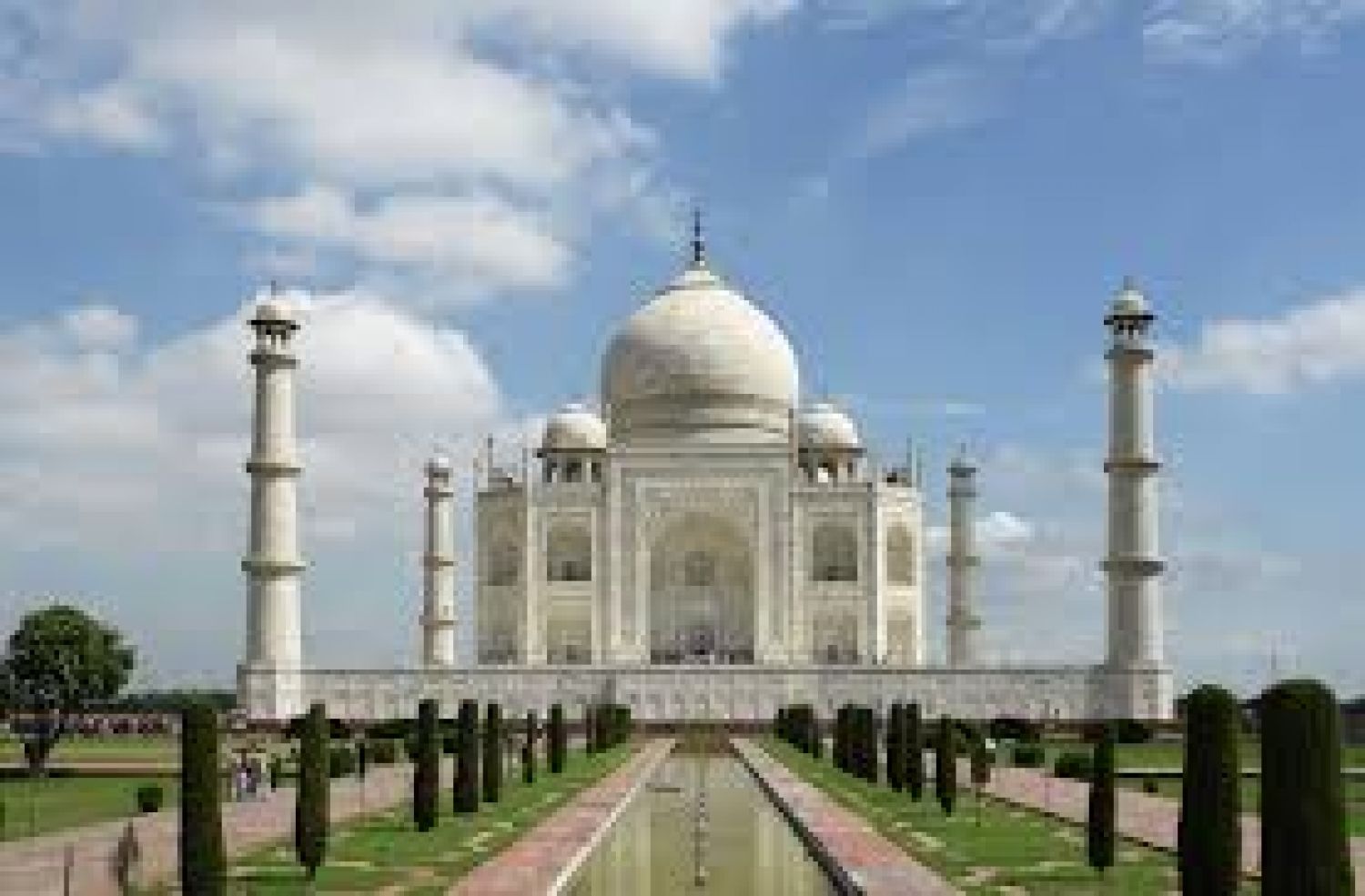
The mausoleum building is the central structure of the entire complex. It is a white marble structure standing on a 6-metre (20 ft) high square plinth with sides measuring 95.5 metres (313 ft) in length. The base structure is a large multi-chambered cube with chamfered corners forming an eight-sided structure that is approximately 57.3 metres (188 ft) long on each of the four long sides.
The predominant feature of the mausoleum is the 23-metre (75 ft) high marble dome that surmounts the tomb. The onion shaped dome sits on a 12-metre (39 ft) high cylindrical drum with an inner diameter of 18.4 metres (60 ft). The dome is slightly asymmetrical and is topped by a 9.6-metre (31 ft) high gilded finial. The intermediate zone between the drum and the dome is supplanted by an ornamental moulding with a twisted rope design.
The main dome is surrounded by four smaller domes or chattris placed at its corners, which replicate the onion shape of the main dome. The smaller domes are supported by columns which stand on the top of the main structure and help bring light to the interior of the building. Tall spires called guldastas extend from edges of walls which serve as decorative elements. The main and the smaller domes are decorated with a design resembling a lotus flower. The domes are topped by decorative finials which uses Persian and Indian design elements.The main finial was originally made of gold but was replaced by a copy made of gilded bronze in the early 19th century The finial is topped by a moon, a typical Islamic motif, whose horns point heavenward.
The Taj Mahal complex is enclosed by crenellated red sandstone walls on three sides, with the side facing the Yamuna river left open. Outside the complex walls, there are other mausoleums dedicated to Shah Jahan's other wives, royals and favorite servants. The inner sides of the walls feature columned arcades, adorned with domed cuppola like chattris and smaller structures like the Music House interspersed between them. The main gateway, primarily built of marble, mirrors the tomb's architecture and incorporates intricate decorations like bas-relief and pietra dura inlays. At the far end of the complex stand two similar buildings built of red sandstone, one of which is designated as a mosque and the other as a jawab, a structure to provide architectural symmetry. The mosque's design resembles others built during the era and the jawab has floors with inlaid patterns while lacking a mihrab.
People from all over the world visit the Taj Mahal to experience one of the wonders of the world. To find out more visit the following website link –
Due to the global attention that it has received and the millions of visitors it attracts, the Taj Mahal has become a prominent image that is associated with India, and in this way has become a symbol of India itself.
Along with being a renowned symbol of love, the Taj Mahal is also a symbol of Shah Jahan's wealth and power, and the fact that the empire had prospered under his rule. Bilateral symmetry, dominated by a central axis, has historically been used by rulers as a symbol of a ruling force that brings balance and harmony, and Shah Jahan applied that concept in the making of the Taj Mahal. Additionally, the plan is aligned in the cardinal north–south direction and the corners have been placed so that when seen from the centre of the plan, the sun can be seen rising and setting on the north and south corners on the summer and winter solstices respectively. This makes the Taj a symbolic horizon.
^Alex Ashworth Director of Creativity